In global mobility (GM), childcare support has traditionally paled in comparison to support with education costs. The latter is viewed as essential for relocating families, whereas many companies have seen childcare as more of a personal choice than an operational requirement. Childcare assistance can also be harder to manage across large mobility programmes and affects fewer children – schooling ages naturally occupy a far wider range.
But its prominence is growing. Dual-career households are ever more common and some companies appear to be recognising that childcare provision is now just as important to the feasibility of assignments and their ongoing success. ECA’s Benefits for International Assignments Survey conducted earlier this year emphasised this. Although the share of companies that always meet childcare costs remains steady at 12%, the proportion that sometimes provide support has more than doubled from 11% to 23% since the last edition in 2021.
It is telling that this increase centres on support sometimes, rather than always, reflecting regulatory, cultural and cost disparities between countries that make it difficult for GM teams to adopt a consistent approach.
The cost chasm
Results from ECA’s latest Childcare Survey show that early-years costs can differ considerably between countries, sometimes by a factor of ten or more.
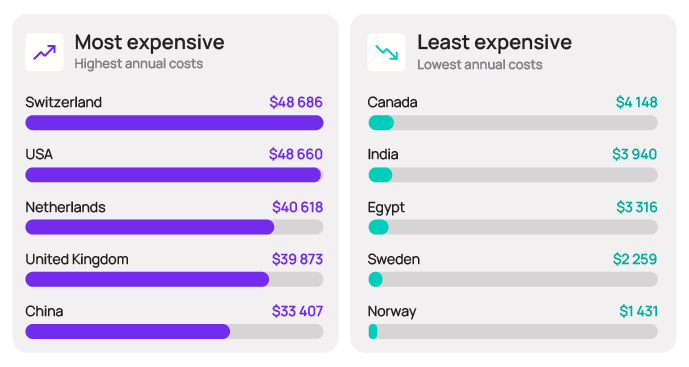
This gulf presents a clear challenge for GM teams: families moving from relatively low-cost childcare markets to much higher-cost locations may require significant company support to maintain feasible arrangements.
Multiple factors drive these differences – from staff-to-child ratios and property costs to labour laws and subsidy structures – all of which can change quickly and differ by city as well as country. For GM professionals managing global budgets, staying informed about these fluctuations is essential.
Navigating cultural expectations
Attitudes towards childcare around the world vary in a way they do not for education, which is near-universally accepted as a right for all. In some places, widespread access to childcare is expected, but in others, cultural expectations place childcare duties within the family unit and the need for external care is considered redundant. This may explain why Asian companies are roughly three times less likely to support childcare than their European counterparts, according to our Benefits for International Assignments Survey.
Within regions, though, differences persist. In China, childcare outside the home is rare and supply is limited to premium, expat-focused services, leading to average annual nursery fees of over USD 33 000. In Japan on the other hand, external childcare is more commonly accepted, the market is well-developed and nursery options are more affordable, at less than USD 16 000 per year.
The impact of subsidies and policy reform
Cultural norms also shape government support for childcare and this can have a huge bearing on the end cost for mobile families – as well as GM teams who are increasingly likely to pick up the bill.
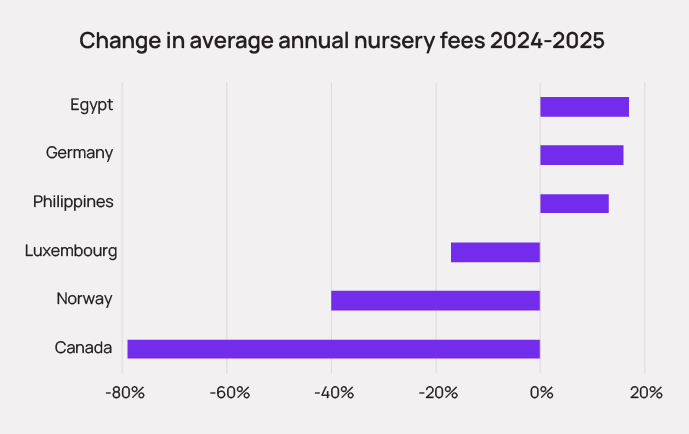
In the USA, where market forces are prioritised, there is no universal childcare programme and government funding is minimal, meaning pre-school fees almost match private school averages at just under USD 50 000 annually. In neighbouring Canada, childcare costs for the consumer are more than ten times lower due to subsidies, including a recent cap implemented in Ontario which has driven down costs by 79%. For families moving from the latter to the former, the realities of an unsubsidised market dominated by private nurseries may collide sharply with their expectations and the cost implications can be significant.
Access to childcare subsidies is often tied to tax residency and income thresholds, factors likely to impact mobile employees living in the host country for a limited period on expat pay packages. This is the case in France, where tight tax residency rules largely prevent access to subsidised nurseries for inbound assignees, instead forcing them to use expensive pre-schools targeted at expats.
And when government support changes, this adds a further layer of unpredictability. In Germany, recent policy reform has dictated that any federal childcare funding must now go towards staff costs, rather than subsiding or waiving fees, resulting in a 16% increase for the consumer. In contrast, further reductions to the already-minimal cap on nursery fees in Norway have slashed costs by 40%. Such measures alter cost gaps between locations and further complicate the task of budgeting company support.
Benchmarking for informed decisions
The result is a complex global picture, with childcare costs varying wildly from country to country, making a universal approach practically impossible to sustain. While GM teams may have little control over the factors behind these disparities, they can strive to stay fully informed on exactly how and where their mobile employees will be affected. With the onus shifting to more company support for childcare costs, this is becoming increasingly important.
In practice, many mobility teams are responding by offering childcare allowances, partnering with local experts to find quality care, embracing hybrid work as a practical support mechanism, and building childcare assistance into broader diversity and inclusion efforts to make mobility more inclusive.
Turn childcare cost data into better mobility decisions
Reliable, up-to-date cost data and country-specific research are essential in designing and maintaining fair and sustainable childcare support.
ECA’s childcare data and consultancy services provide that foundation, enabling mobility teams to benchmark allowances against real market rates, forecast costs and budget for policy or subsidy changes, and design or review childcare support frameworks that reflect both business needs and employee realities. With these insights, organisations can move from reactive decision-making to strategic planning, ensuring every assignment remains feasible, cost-effective and attractive for the families involved.
Get in touch to find out how ECA’s childcare benchmarking can support your mobility decisions.