ECA’s latest Location Ratings review reveals how political unrest, shifting social dynamics and natural disasters reshaped hardship conditions for expatriates around the world in 2025.
While the majority of the 510 published cities saw only modest movements, 2025 brought a series of other significant pressures – from election-related violence to major natural disasters and shifting cross-border dynamics – that contributed to marked score increases in a number of locations and underscores the importance of monitoring global developments.
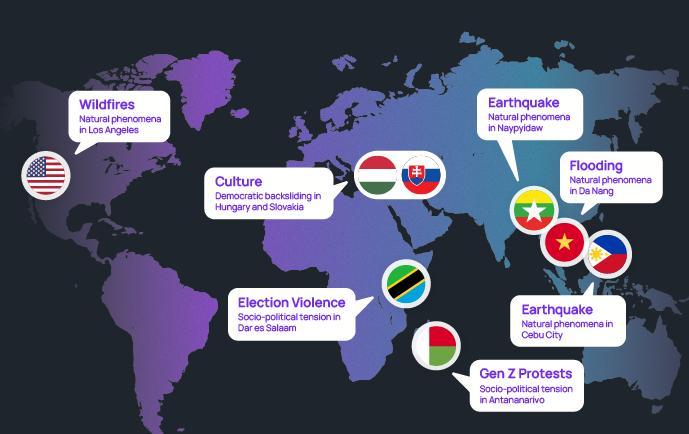
2025 locations with marked score increases
Youth mobilisation redefines local stability
Youth-led demonstrations became a prominent feature across the world in 2025, reflecting growing political engagement (and dissatisfaction) among younger populations. These protests caused disruption and even additional danger for assignees in cities where violence occurred.
In Madagascar and Nepal, youth-led protests intensified amid economic and political pressures. In Antananarivo, early Gen Z-driven activism evolved into broader anti-government unrest, with clashes between protesters and security forces resulting in fatalities, injuries, and widespread disruption. Similar tensions flared in Kathmandu, where proposed social-media restrictions and corruption allegations prompted violent confrontations and attacks on government buildings. In both cases, ECA’s Socio-Political Tensions scores rose accordingly, leading to higher location allowances for some expatriates.
Kenya experienced a parallel rise in youth activism, driven by concerns over economic policy, public-service conditions and the conduct of security forces during periods of unrest. Youth-driven protests also gained momentum in Morocco and Togo, where grievances centred on spending priorities, political reform and employment prospects. Across these locations, decentralised and social-media-driven organising emerged as a defining feature of the movements. However, as civil unrest and political instability factors are already considered in ECA’s analysis, the impact on scores was limited.
Ballots and backlash: election-related violence
Election-related violence was a recurring challenge in several locations in 2025, driven by highly contested polls and declining public confidence in electoral institutions. In many cases, tightened political control and weakened opposition structures contributed to tense pre- and post-election environments, with authorities often responding to dissent through restrictive or violent measures.
In Tanzania, the fallout from the general election was particularly severe, with intense clashes between security forces and demonstrators, reported fatalities, and the imposition of a state curfew in Dar es Salaam. ECA applied a score increase to the Socio-Political Tensions score to reflect the scale of disruption and the severity of the security response.
Cameroon saw similar pressures, with contested polls and a heavy security presence shaping the electoral period. Ongoing questions about the credibility of the process, alongside reported fatalities and disruptions, resulted in a higher Socio-Political Tensions score.
Democratic concerns in Central Europe
Beyond environmental risks, political and social pressures also shaped the conditions for assignees in 2025.
These pressures in Hungary and Slovakia contributed to higher culture scores in 2025, reflecting democratic backsliding across parts of Central Europe. Under the Orban administration, civil society in Hungary has faced tighter constraints and protections for LGBT communities have been progressively curtailed, creating a more restrictive environment for expatriate staff. In neighbouring Slovakia, reforms introduced by the government of Prime Minister Robert Fico have been criticised for undermining judicial independence, centralising control over media, and limiting civic space. These developments have caused additional challenges for international assignees, leading to higher scores for both countries.
Cautious optimism for peace and de-escalation
Not all developments were negative. There were signs of good news in several regions, with diplomatic steps taken toward easing long-running tensions.
Relations between Thailand and Cambodia remained intermittently strained by long-standing border disputes, but elsewhere progress was more visible. In March 2025, the PKK, a longstanding Kurdish insurgent group, announced a ceasefire with Türkiye, ending decades of ongoing conflict. The Democratic Republic of the Congo and Rwanda signed a peace agreement in June 2025 aimed at restoring state authority and reducing cross border insecurity, and Armenia and Azerbaijan initialled a deal in August 2025 to normalise relations and delimit their border. There have also been limited diplomatic steps in the Russia-Ukraine conflict, suggesting some potential for progress.
While implementation in all cases remains fragile and, in some instances, has already stalled, these developments signal movement in the right direction. ECA takes a long-term view when assessing stability trends and therefore scores have not been immediately reduced, although further sustained progress may support future adjustments.
Climate and disaster risks intensify
Environmental and climate-related hazards were a prominent feature of 2025, with several regions experiencing severe natural disasters that caused extensive disruption and humanitarian strain.
Wildfires were recorded in multiple locations during periods of extreme heat and dry conditions, prompting large-scale evacuations, extensive damage and significant pressure on emergency-response systems. Incidents in Los Angeles drew significant attention due to their proximity to densely populated areas and the substantial financial losses reported, resulting in an increase in the Natural Phenomena score. Across the Atlantic, Spain and Portugal also faced a severe wildfire season, with studies noting that fires across the Iberian Peninsula burned hundreds of thousands of hectares and were made more likely by climate change.
Elsewhere, major earthquakes in Myanmar and the Philippines resulted in widespread structural damage, casualties and prolonged recovery needs, particularly in areas where infrastructure was already fragile. As a result, Natural Phenomena scores increased in both Naypyidaw and Cebu City. Heavy seasonal rainfall also contributed to destructive flooding in Vietnam, inundating homes, displacing communities and interrupting essential services in Da Nang, which also saw a score increase in this category.
Taken together, these events underscore the growing scale and frequency of climate- and disaster-related risks affecting both urban and rural populations, a trend ECA will continue to monitor closely.
An evolving Location Ratings methodology
As part of ECA’s ongoing commitment to innovation and continuous improvement, ECA modernised two key components of our Location Ratings methodology in 2025. Updates to Internal Isolation and Personal Security ensure we produce an ever more accurate reflection of on-the-ground realities for international assignees.
The Internal Isolation section now considers overall road conditions, including traffic flow, pedestrian infrastructure and signage, rather than road quality alone. The assessment also now evaluates private delivery services alongside public postal systems, while placing greater weight on mobile and broadband connectivity, reflecting the importance of these issues to expatriates.
In the Personal Security section, new questions on police presence and the general urban environment allow the capture of local conditions not previously reflected in the ratings. Some locations see small changes in score owing to these updates, allowing an ever more accurate view of the challenges facing international assignees in their host locations.
Looking ahead to 2026
ECA will continue to monitor key flashpoints. This includes ongoing conflict in the Middle East and the continued effects of the Russia-Ukraine war, as well as upcoming national elections that have the potential to trigger unrest in various locations, such as in Bangladesh, where the political environment remains sensitive.
ECA will also track other areas experiencing elevated risk or disruption to ensure we continue to provide you with the data you need to anticipate change and support your employees, wherever you operate.
Want to understand how these trends impact your assignees?
Get in touch to further explore ECA’s Location Ratings or discuss your key locations.