The landscape of international school fees has evolved in 2025, and the effects are already being felt in mobility budgets. In this blog, we take a detailed look at the key trends shaping costs this year, from the most expensive marked and fee inflation hotspots to the impact of USD pricing and new tax policies.
How international school fees shape mobility decisions
In assignment proposals, some costs resonate more strongly than others. Education is a clear example: securing high-quality schooling is often a non-negotiable condition for relocating families and a key factor in ensuring a smooth move.
It is therefore unsurprising that education support is widespread. ECA’s latest Benefits for International Assignments Survey found that 81% of companies provide it, and 40% of these cover tuition fees with no limit. With employers frequently meeting costs in full, understanding where international school fees are rising – and why – is essential for effective budgeting and policy design.
So where are these costs having the biggest impact on mobility budgets, and what factors are driving them?
Which countries have the highest international school fees in 2025?
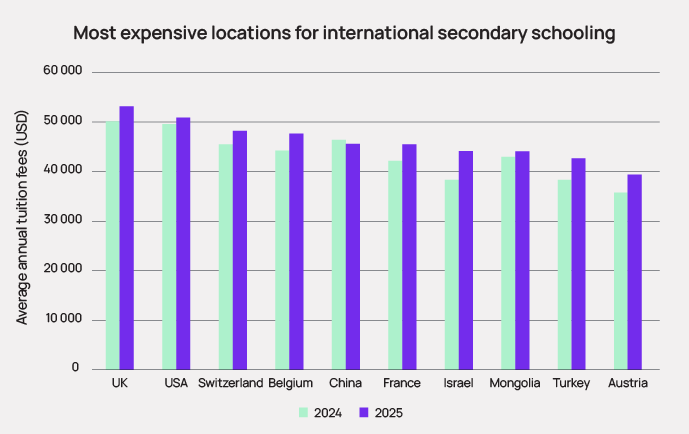
According to ECA’s 2025 International Schools Survey, the UK and the USA continue to be the two most expensive countries globally, with average annual international secondary school tuition fees topping USD 50 000 in both. The top 10 has remained broadly consistent in the past year and is still largely made up of European countries. Its two Asian representatives, China and Mongolia, have slid slightly down the rankings, with fees actually falling in China. Notably, however, China remains around one-third more expensive than Singapore and Hong Kong.
Some countries have seen significant fee inflation since last year’s survey, including Ghana (+23%), Brazil (+16%) and Poland (+13%). For Brazil and Poland in particular, correlation with the growing popularity of these destinations for international assignments is unlikely to be a coincidence, as prices rise to meet greater demand for international education.
On the flip side, international school costs in certain large expat markets – India, South Africa and Ireland – remain relatively modest, typically no more than USD 16 000 per year. In India and South Africa, long-established supply and relatively low operating costs help keep fees contained. In Ireland, a strong public school system reduces reliance on international schools, limiting upward pressure on prices.
 How USD-denominated pricing is shaping international school fees
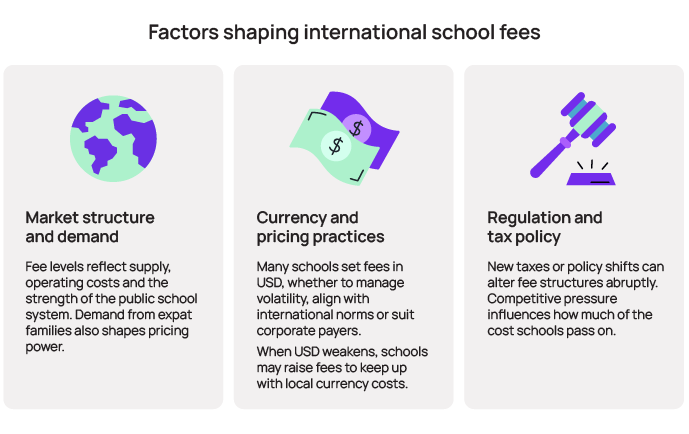
Many international schools set fees in USD, whether to manage currency volatility, align with international market norms or match the budgeting practices of multinational employers. This year’s unexpected weakening of the US dollar disrupted this approach. Schools charging in USD saw their real income fall relative to rising local-currency costs, prompting corrective fee increases.
As a result, USD-priced international school fees have risen sharply in several countries – including by 24% in Democratic Republic of the Congo and 11% in Turkey – adding new complexity for GM teams already navigating currency volatility and payment restrictions.
ECA’s data reflects how fees are actually paid, updating costs in local currency where this is standard practice, such as in Ghana and Egypt. This ensures that cost estimates mirror the financial reality encountered by employers.
How new taxes are affecting international school costs
The sudden imposition of taxes on international school fees can add uncertainty for GM teams, particularly where costs have historically remained stable and budgeting approaches have become entrenched.
In such cases, it might be expected that schools pass on the added expense directly to those paying the fees. This appears to have happened in Malaysia, where a new service tax applicable on annual fees above MYR 60 000 – a threshold that captures several international schools popular with expat families – has contributed to a double-digit annual rise in costs.
Interestingly, a different outcome seems to have unfolded in the UK, where the government has lifted VAT exemption for private schools in the past year. Fee inflation since last year’s survey stands at 4%, lower than average wage growth over the same period. Some schools may be absorbing part of the additional cost rather than passing it on, perhaps to strengthen their competitive position in a crowded marketplace.
Empowering GM teams to support families: why education benchmarking matters
School fees change annually, but the broader landscape – application cycles, capacity constraints, currency effects and taxation – shifts continuously. Regular benchmarking of education allowances allows GM teams to anticipate pressure points, adjust budgets proactively and avoid last-minute challenges for relocating families.
ECA supports organisations at every stage of this process. From detailed Education Reports to tailored analyses on curricula, language needs or specific markets, our resources help ensure that your international school fee support remains accurate, competitive and cost-efficient.
Get in touch today to find out how to access detailed international school fee data in 168 countries with ECA’s Education Reports.