This year's World Meteorological Day carried a simple tagline: 'Observing Today, Protecting Tomorrow'. Although the focus is aimed at climate science, it carries relevance for global mobility (GM) right now.
GM is an industry built on observation – benchmarking, cost tracking, compliance monitoring and policy reviews to name a few examples. However, when today keeps getting more complicated, the 'protecting tomorrow' side often takes a back seat. Conflict across the Middle East and beyond is forcing mobility teams to manage emergency evacuations and rethink assignment viability at pace. In addition, cost pressures have sharpened further. With that backdrop, where does that leave sustainability initiatives, so much a focus until recently?
When the present crowds out the future
Sustainability is still a concern for many organisations, but the gap between stated commitment and operational reality has quietly widened for global mobility teams.
Sustainability entered GM largely on the back of corporate ESG commitments made when budgets were more stable and the geopolitical map looked different. Many of these commitments were genuine, but they were made when making them was relatively low cost. Commitments that require real investment – greener relocation options, emissions tracking and reporting infrastructure, etc. – tend to be the ones that lose out when budgets tighten or GM teams are consumed by more urgent problems such as those being seen in the Middle East.
The sustainability audit
The most revealing approach is not to ask what companies say about sustainability – it is to look at what they are doing and why. Across relocation, travel and assignment strategy, the data shows a consistent pattern: sustainability is present, but rarely the primary driver of decision-making.
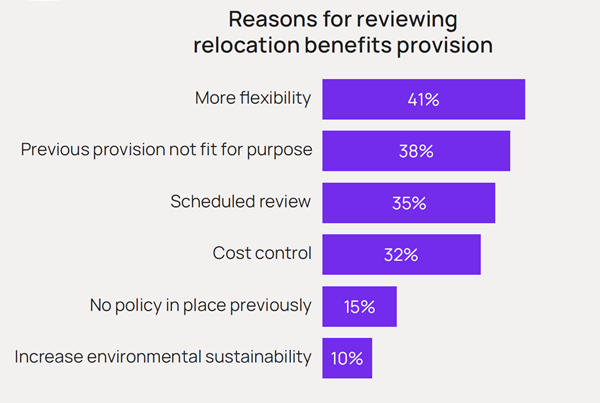
Relocation support for long-term assignments is one area focused on at the height of the sustainability debate. According to our recent International Relocation Benefits Survey, 44% of companies reviewed their relocation benefits provision in the past year, up from 30% in the previous survey cycle. However, sustainability barely registered as a factor, with only 10% citing it as a driver of the review. Instead, cost control, flexibility and addressing provision that no longer met current needs dominated.
Travel tells a similar story. The proportion of companies stipulating economy class for all employees on relocation flights has nearly doubled since 2021, from 23% to 42%. Looking at home leave travel, ECA’s Benefits for International Assignments Survey shows that economy class is now the norm across all seniority levels and flight durations. While the sustainability impact of this is real, so are the cost savings, and the latter is the key driver.
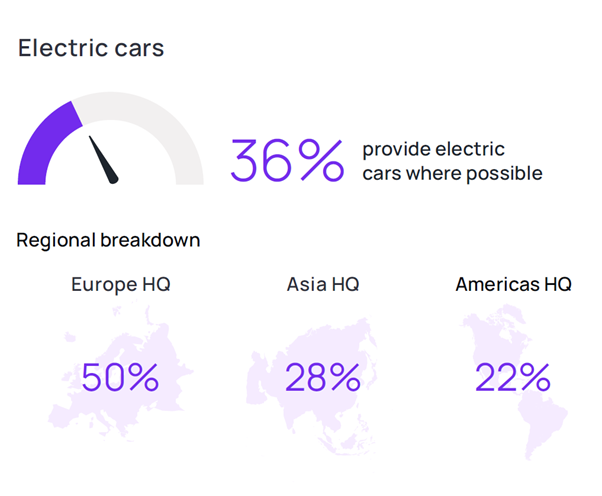
Transport policy within global mobility programmes is where the picture becomes more mixed. The Benefits for International Assignments Survey shows that having the option to provide public transport allowances instead of cars is increasing. In addition, over one-third of companies now favour electric vehicles when car benefits are provided, rising to half of European-headquartered organisations. That is not purely cost-driven, but the regional variation is instructive: EV preference drops to 28% in Asia and 22% in the Americas, tracking closely with charging infrastructure and incentive structures rather than any meaningful difference in corporate intent. Again, sustainability is a factor, but practicality is more important.
The same pattern holds when looking at the assignment mix. Early results of the 2026 edition of Global Mobility Now show that long-term assignments have decreased in 44% of organisations in the past two years, while international remote work has increased in more than half. Taken in isolation, this would suggest a positive shift from a sustainability perspective.
However, looking at the broader picture shows that the driver of the drop in long-term assignments is not a deliberate reduction in the number of physical moves, but rather a shift towards more flexible arrangements that align with cost management and talent strategy. International remote work may have increased, but over 40% of organisations also saw short-term assignments, international commuter arrangements and business trips increasing over the same period. Any sustainability benefits from a change in the profile of mobility types appears to be incidental rather than intentional.
Does it matter?
There is a reasonable counter-argument: if the changes result in lower emissions whether or not that was the intention, do the outcomes not speak for themselves? That is true, but only to a point – and for global mobility functions, the distinction matters more than it might appear.
Decisions made for cost reasons are liable to reverse when the situation changes, whereas decisions anchored in genuine sustainability commitment are more resistant to that reversal. The distinction becomes visible when conditions shift – when conflict demands emergency mobility at speed and expense, or if a talent shortage makes long-term assignments more attractive. In those moments, sustainability that was effectively cost control starts to disappear.
GM is well-equipped to observe. Protecting tomorrow is harder – and the data suggests that for many organisations, it has stopped being a priority. That may change when cost pressures ease and geopolitical risk recedes, but will require greater commitment to avoid it being sidelined once again.
From observation to action
Understanding where sustainability genuinely sits in your programme starts with knowing what others are doing.
ECA's benchmarking surveys cover the full breadth of international mobility topics, with data from hundreds of organisations globally. Participants always receive complimentary access to survey report and full dataset, with the ability to filter the results to personalise your own benchmarks.
For those who want to go deeper, whether you want to benchmark your current approach, explore the findings in depth or talk through what the data means for your programme, our Consultancy team is on hand to help.
To be notified when our next survey launches, or to speak with a member of the team, please get in touch.