Education is high on the global mobility (GM) agenda, but why it is so important to stay on top of ever-changing costs?
For GM teams tasked with supporting family-led assignments, education provision is often a key strategic priority. Access to the right education can shape not only a child’s development, but also a family’s willingness to relocate, how well they settle in the host location and the ultimate success of an international move.
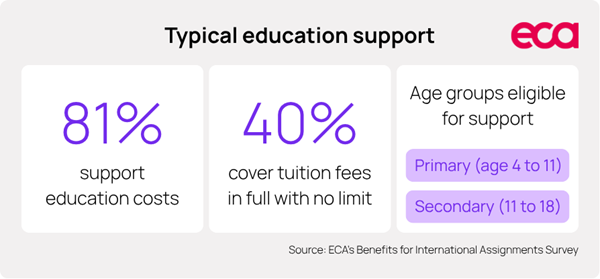
Our latest Benefits for International Assignments Survey found that 81% of organisations provide financial assistance with schooling costs for the children of long-term assignees. Yet despite support being widespread, education costs can be uniquely complex. They are susceptible to a range of location-specific factors that can impact how effectively provision is managed across mobility programmes.
Why education costs are so complex
Fees can vary significantly not only between countries, but between schools within the same city. Differences in curriculum can add another layer of variation. Our newly published Education data provides a clear view of school fees across locations and helps organisations stay aligned with market conditions.
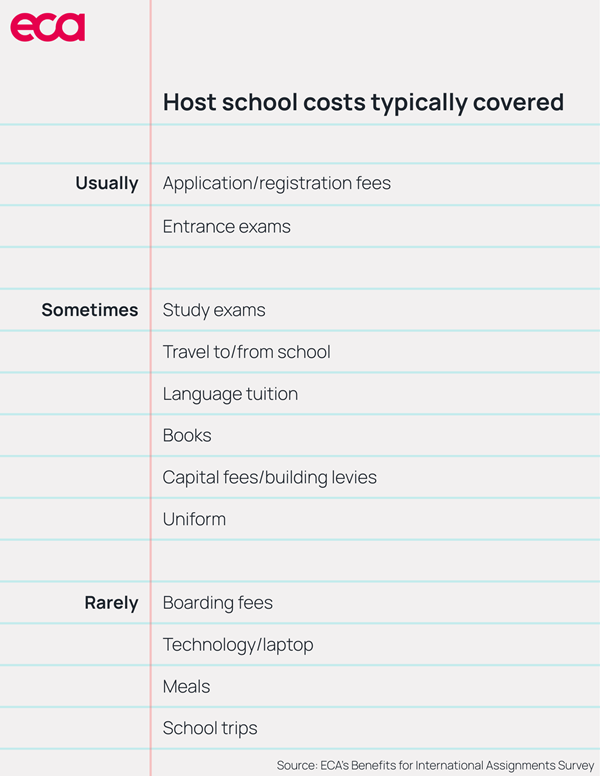
Beyond tuition fees, additional expenses such as registration fees, capital levies, transport and uniforms can also add up. Insights from the Benefits for International Assignments Survey help organisations understand how these elements are typically supported, providing useful context when designing education policies.
Currency movements can further complicate the picture, making it difficult to maintain an accurate, up-to-date view of costs over time. In short, education is not a cost category that lends itself to broad assumptions.
The risk of getting it wrong
Failing to keep pace with these factors can create real challenges. Underestimating school fees can quickly lead to budget overruns, particularly in locations where demand for international education far outstrips supply. At the same time, relying on outdated benchmarks can result in inconsistent or uncompetitive policies, undermining both fairness and employee trust.
Turning complexity into clarity
Along with the policy-level insights in the Benefits for International Assignments Survey, ECA’s Education data offers global coverage and is updated twice a year, with robust, comparable information on international school fees.
This enables organisations to design education allowances that are both competitive and cost-effective, while supporting more accurate budgeting and planning. It also strengthens internal decision-making, giving you the confidence to align policies with real market conditions rather than estimates or anecdotal evidence.
Want to see how this could work for your organisation? Get in touch with our team to explore ECA’s Education data in more detail and discuss how it can support your mobility strategy