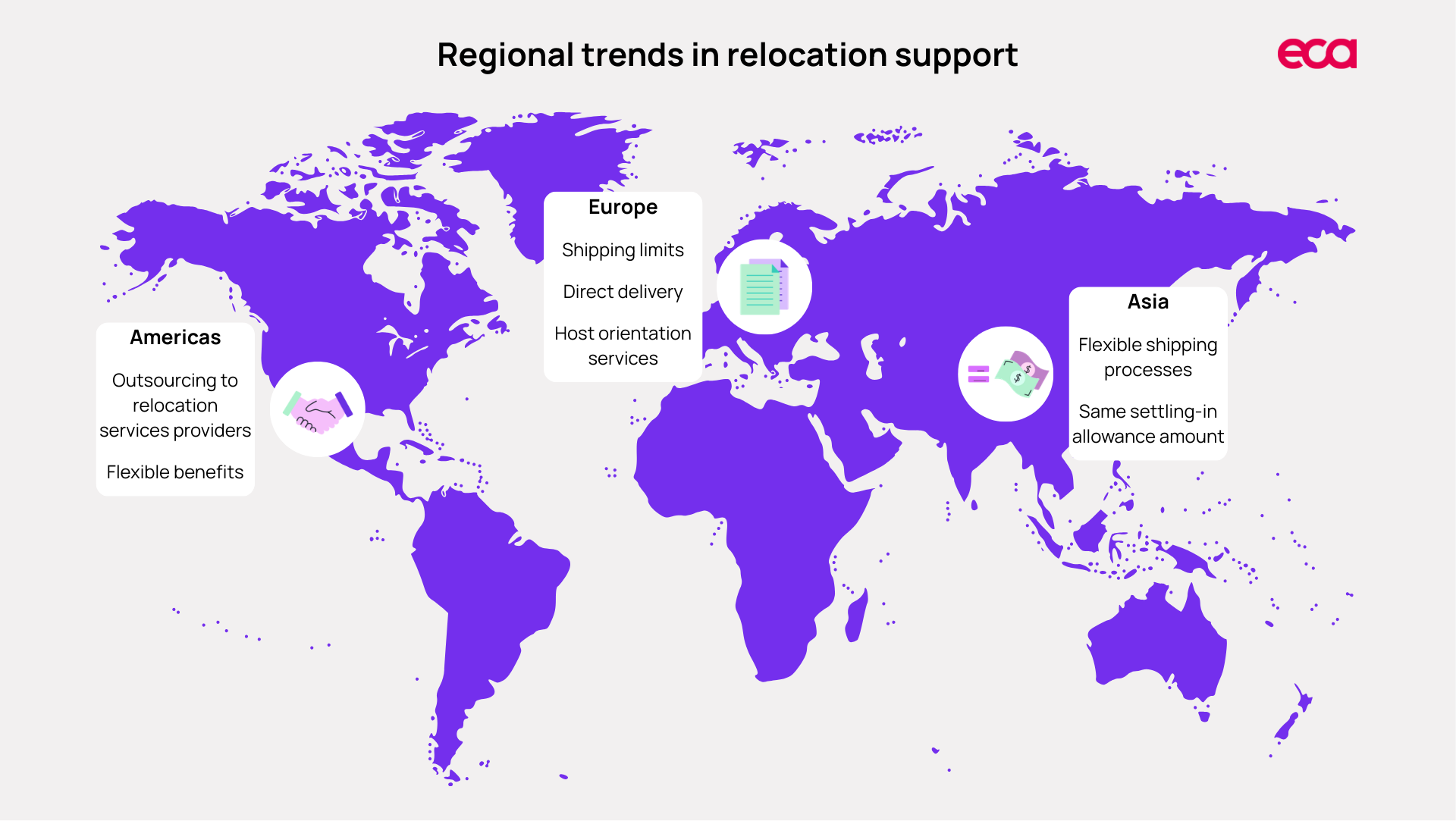
Global mobility (GM) is defined by significant variation across locations. Cost structures, talent expectations and regulatory environments differ widely, creating complex challenges for GM teams moving employees from one country to another. Comparing policies at a regional level can therefore be a valuable way to balance overarching programme goals with local realities.
Drawing on findings from our recent International Relocation Benefits Survey, several distinct regional approaches emerge in how companies support employees relocating abroad.
Europe: governance and targeted support
European companies tend to prioritise tighter governance. They are more likely to impose shipping and storage limits and to deliver relocation support directly, as cost control and compliance concerns remain high on the cultural agenda. A close eye on costs may also mean identifying specifically where support is most effective. They more commonly cover host orientation services and a wider range of support with settling-in allowances, areas which can have a big impact on acclimatising smoothly, without blowing the budget.
Asia: flexibility and operational efficiency
Asian companies can be more adaptable and more willing to allow different approaches depending on the move. They are less likely to require specific shipping methods or providers or to insure shipped goods, emphasising speed of process, even if at the expense of cost oversight and consistency. Less granular cost focus may also drive paying the same settling-in allowance for all assignees worldwide, limiting administration, but possibly affecting efficiency of support in some places.
Americas: outsourcing and employee choice
Companies based in the Americas use relocation services providers most extensively, due to a large, well-developed domestic relocation market, where outsourcing is the typical way to manage the relocation process. Flexible relocation benefits are also more common in the region, reflecting a culture that leans towards individual choice and responsibility.
While these regional patterns are not universal, they highlight how cultural norms, market maturity and governance priorities shape global mobility strategy. For organisations operating internationally, understanding these differences is key to designing programmes that achieve consistency where needed, while remaining responsive to local context.
Benchmark by region for real market insights
Taking a regional lens to benchmarking can help ensure your mobility programme remains competitive, compliant and successful in varying local contexts around the world.
ECA’s consultancy experts provide help with designing, reviewing and health-checking mobility policies. Get in touch for more details.