Two years ago, global mobility (GM) was in a state of rapid change and disruption. Long-term assignments were becoming less prominent, international remote work was increasingly widespread and artificial intelligence was entering mainstream conversations.
The launch of the 2026 edition of Global Mobility Now provides a timely opportunity to assess how far that disruption has continued. Across topics such as AI, technology and compliance, the results will show whether mobility teams are genuinely transforming, or simply adapting at the margins.
Below are some of the key themes facing global mobility teams in 2026.
The mobility mix: a new equilibrium?
In 2024, long-term assignments remained dominant but were declining proportionally, while permanent transfers and international remote work continued to rise.
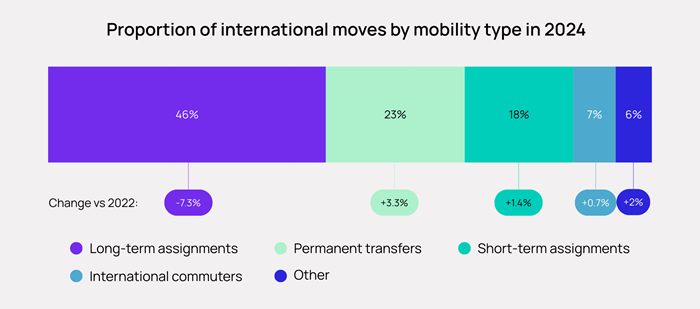
The results of the 2026 survey will show not only how move types have changed in the last two years, but how organisations expect them to evolve in the next two.
Among the questions explored:
- Are traditional home-based assignments continuing their relative decline?
- Are permanent transfers still the second most common mobility type?
- Was the surge in cross-border remote work temporary?
The mix of mobility types directly affects cost models, compliance exposure and the operating model of the GM function itself, giving the results extra importance.
AI: from promise to practicality?
Two years ago, only 20% of organisations had believed AI was useful to their GM functions. However, 70% believed that it would be useful in two years’ time. The spread of AI over the past two years shows that the issue is no longer whether AI has potential, it is whether mobility teams have converted that potential into structured capability.
The survey will test:
- Are AI tools embedded in standard workflows, or just confined to informal individual use?
- Has governance kept pace with experimentation?
- Is AI improving compliance oversight and decision quality, or simply saving time on administrative tasks?
With many mobility teams now testing what AI can deliver, understanding where you sit compared to your peers provides clarity on where your programme is ahead of the curve, and where it is underdeveloped.
Technology: incremental improvement or infrastructural shift?
Technology is often the engine of mobility transformation. However, the 2024 survey showed that most organisations were operating within incremental improvement cycles rather than larger-scale digital transformation.
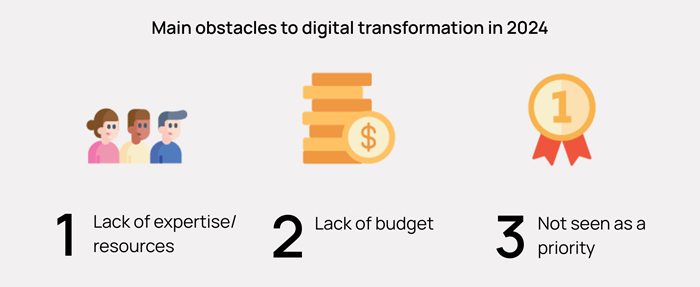
Budget limitations, limited team capacity and competing priorities mean that even where the ambition exists, progress can be uneven. The 2026 edition looks at where technology is delivering the greatest value in GM right now.
The results will help answer:
- Is mobility technology still layered on top of manual processes?
- Are resource constraints slowing necessary structural change?
- If investment is limited, where does technology create the greatest measurable value?
In an environment of growing complexity and scrutiny, the cost of inaction may quietly exceed the cost of implementation.
Compliance: reactive management or embedded architecture?
Compliance has always been central to global mobility, but as cross-border remote work expands and regulatory frameworks evolve, mobility teams face greater scrutiny and more complex risk exposure than ever before. The survey will explore how this is affecting the day-to-day management of mobile employees.
Key areas the survey will address:
- Is compliance architecture integrated across mobility and business travel?
- Are employee movements tracked systematically and proactively?
- When thresholds are breached, is the response automated, formalised or informal?
As regulatory attention increases, compliance is no longer a control function, it is a design principle.
Where does your programme stand?
Across mobility mix, AI maturity, technology architecture and compliance integration, Global Mobility Now captures the key insights into the mobility trends of 2026 and beyond.
Take part in the survey by 11 March to secure a free copy of the report and detailed results, allowing you to benchmark your approach against peers across regions and industries.
For teams looking not only to benchmark but to act on the findings, ECA’s Consultancy team works with organisations to interpret the findings, assess programme maturity and design practical steps towards stronger compliance, smarter technology use and more strategic mobility models.